You don’t need a fifth diet
Summary: Skip breakfast. No bread. Count when you remember. Shakes on weekdays. That is four diets running at once, collected from four different places, none of them built to sit on the same plate. The research says the thing that decides whether any of it works is whether you can stick to it, which is exactly what four rules make impossible. The answer is not another one. It is one that replaces all four.
Ask most people who have been trying to lose weight what diet they are on, and they will tell you they are not on one.
Then look at what they actually do in a week.
- 01Skip breakfast, eat after noonFrom a podcast about fasting, about three years ago
- 02No bread, no pasta, no riceFrom a friend who lost weight cutting carbohydrates
- 03Count calories, when you rememberFrom an app downloaded in January
- 04A shake instead of lunch on weekdaysFrom whatever was on offer at the store
That is four diets. Intermittent fasting, low carbohydrate, calorie counting and meal replacement, running at the same time, in the same week, on the same body.
Not one of them arrived with the others. Each was picked up on its own, from a different person, at a different moment, for a different reason. Nobody ever sat down and checked whether the four of them work as one thing.
They don’t. And that turns out to matter far more than which four they are.
The thing that decides whether a diet works is not which diet it is
In 2005, JAMA published a trial that took 160 adults and assigned them to four of the most argued-about diets of the era: Atkins, Ornish, Weight Watchers and Zone. Then it followed them for a year.
The four diets finished close together. What actually separated the people who lost weight from the people who did not was not the diet they had been handed.
The authors’ own conclusion: sustained adherence, rather than the type of diet, was the key predictor of how much weight came off. Average one-year loss was modest in every group, and every group had people who did well and people who did not.
Thirty years of diet argument, compressed into one sentence: sticking to it beat picking the right one.
Which is a difficult finding if you are following four.
Four rules that contradict each other cannot be stuck to
You cannot fully follow a fasting window, a calorie target, a no-carbohydrate rule and a shake schedule at the same time. They collide. The fasting rule pushes lunch later, the shake rule says lunch is at noon, the carbohydrate rule quietly removes the food that would have made either one filling.
So you follow each of them partially. And partial adherence to four plans is not adherence to one. You do the hard part of every diet and get the result of none of them.

Most people are not failing to try. They are trying at four things at once.
It also does not last long, and there is data on that too. When researchers estimated how long new dieters actually persist, using search behavior across a full year, the answer came back in weeks rather than months.
Weeks. Average persistence for people starting a new diet, ranging from 3.1 weeks on the shortest-lived plan to 5.8 on the longest. Dropout clustered hard in November and December, before the January restart. Towers et al., Public Health Nutrition, 2020.
Read those two findings next to each other and the picture is not flattering to the diet industry, but it is flattering to you. Sticking to something is what works. Almost nobody gets to stick to anything, because what they have been handed was never designed to be stuck to in the first place.
The pattern is not “I have no willpower.” The pattern is “I am working hard at a system nobody designed.”
What a designed plan actually means
The GOLO for Life® Plan is not a fifth rule to add to the four. It is built to replace all of them.
It is one set of eating guidance where the parts were made to work with each other: what goes on the plate, roughly how much of it, and what to do when progress stops. Written by GOLO’s team of doctors, nutrition experts and behavior experts, and delivered as something you can hold rather than something you have to remember.
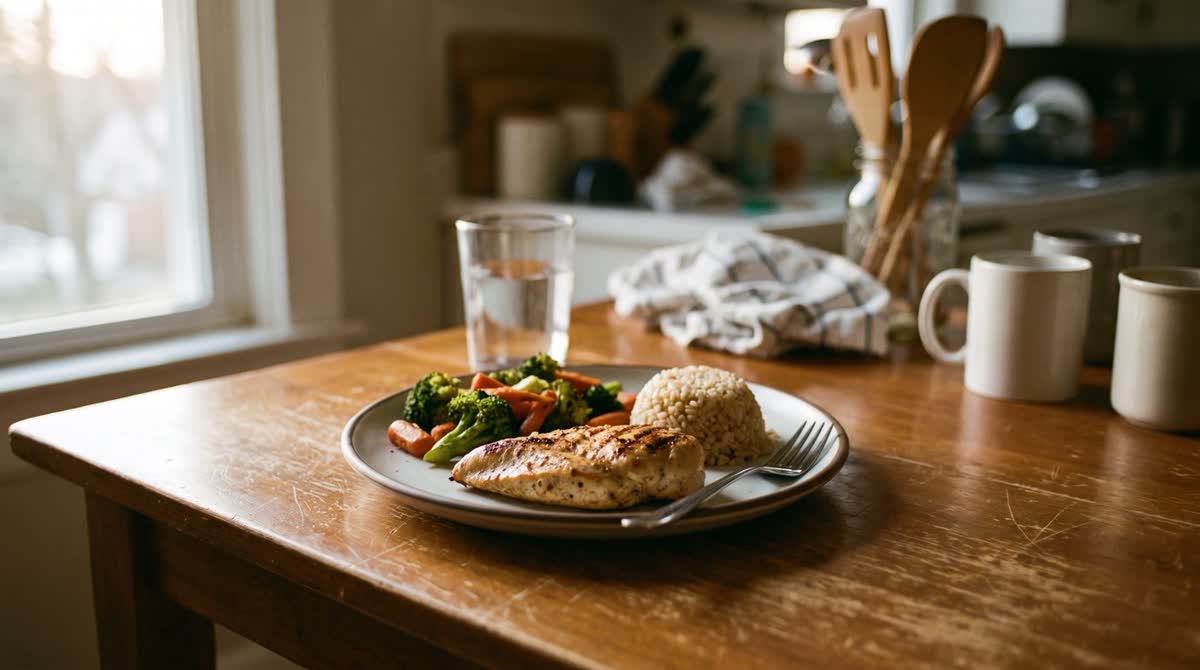
The shape of the plate stays the same. What sits in each part of it is up to you.
The plate has a shape, and the shape does not change
That is the structure behind GOLO’s 2-1-2-1 nutrition guidance, and it holds on a Tuesday, at a restaurant, and at a holiday table. What changes is what you put in each slot, not the slots.
Note what is not in that list: nothing branded, nothing shipped to you, no food group removed. Carbohydrates stay. It is real food, bought at a normal grocery store, cooked for the whole household rather than isolating you with a different meal.
It answers the two questions your four rules never did
1. “So what do I actually eat?”
This is the question every collected rule fails at. “No bread” tells you what to remove. It does not tell you what dinner is.
The Plan answers it on paper, in four short booklets, with the food, the portions and a simple understanding of what makes a balanced plate. There is also a GOLO Smart Card® for meal guidance, which you can keep in a bag, on the counter or fridge, or on a desk at work, with no app to open.
2. “What do I do when it stops working?”
Every plan works for a while. Then there is the week where nothing moves, and no plan anyone has ever bought had a page for that week. So the stall gets read as personal failure, and that is usually where it ends.
One of the four booklets is called Overcoming Diet Obstacles. It is 28 pages, and it exists because the stall was expected and planned for. That is a promise only a written program can make.

The difference between rules you collected and a plan you were given is that one of them anticipated this week.
What actually arrives
The Plan is a physical kit. It is worth being precise about what is in it, because “a plan” is the vaguest word in this category.
- Your Roadmap to Success15 pages
- The GOLO 2-1-2-1 Diet and The Healing Power of Foodtwo booklets
- Overcoming Diet Obstacles28 pages
- GOLO Smart Card for meal guidancekeep it in a bag
- GOLO wrist bandincluded
- myGOLO® online accessfree with your first order
- Free in-house support from the GOLO teama person, not a chatbot
It arrives, and it is yours to keep. There is no login that expires and nothing to cancel later.
If you are taking a GLP-1 medication
Then you already have help with one half of this, and none with the other. A GLP-1 medication works on appetite. It does not decide what goes into the grocery basket, and it does not teach anybody how to build a plate.
The Plan is the eating side of it, alongside the medication and after it. Nothing here asks you to change anything about a prescription. Those decisions belong with you and your doctor.
What the Plan will not do
Worth saying plainly, because everything above is the case for it.
- ✕It will not let you eat without paying any attention. It is guidance about food, so the food changes.
- ✕It will not work from inside the box. This is a plan you read and then use.
- ✕It is not a fast plan. GOLO’s own guidance is a steady pace, in the region of 1 to 2 lbs a week, and individual results vary.
- ✕It does not remove cooking. Real food means someone makes dinner.
- ✕It is not something to run alongside your other four rules. It only does its job if it replaces them.
The offer

The GOLO for Life Plan
The complete printed kit, plus online access. Bought on its own, with no bottle attached and nothing recurring behind it.
One plan, designed as one thing
Four booklets, the GOLO Smart Card, the wrist band and myGOLO access, delivered to you.
No monthly payments or subscriptions ever.
- Four booklets written by GOLO’s doctors, nutrition experts and behavior experts
- GOLO Smart Card for meal guidance, and the GOLO wrist band
- myGOLO online access, free with your first order
- Free in-house support from the GOLO team
- Yours to keep, with nothing to cancel
Purchase anytime. No subscription. Backed by a 60-day money-back guarantee. Individual results vary.
If it is not for you, call or email GOLO within 60 days for a return authorization number. The guarantee is good on a first order of a product and limited to one return per customer per product. Items must come back complete, and shipping costs are not refunded. Full terms here.
Questions people ask first
Is this a subscription?
No. There are no monthly payments or subscriptions ever. You buy the Plan, it is delivered, and it is yours. Purchase anytime. No subscription. Backed by a 60-day money-back guarantee.
Do I have to buy Release® as well?
No. The Plan is a complete eating program on its own and it is sold on its own. Release is a separate GOLO product, designed to support the Plan rather than to replace it. Plenty of people take both and plenty of people take only the Plan. Nothing here requires the other.
Do I have to buy special food?
No. There is nothing branded to buy and nothing shipped to you on a schedule. The Plan is built around food from a normal grocery store, cooked at home, and it is designed so the household can eat the same dinner.
I have tried a lot of plans. Why would this be different?
Because most of what you have tried was not a plan, it was a rule. A rule tells you what to remove. This tells you what a meal looks like, what to do in the week nothing moves, and how to keep doing it when the first month is over. Whether that is worth $39.95 to you is a fair question, which is what the 60-day refund is for.
How quickly does it work?
GOLO’s own guidance is a steady pace rather than a fast one, in the region of 1 to 2 lbs a week. Individual results vary, and anyone promising you a number without knowing anything about you is guessing.
Can I follow it if I am on a GLP-1 medication?
Yes. The Plan is about food, so it works alongside a medication and after it. Any decision about the medication itself belongs with you and your doctor.